Electric Vehicle Chargers

The Bottom Line
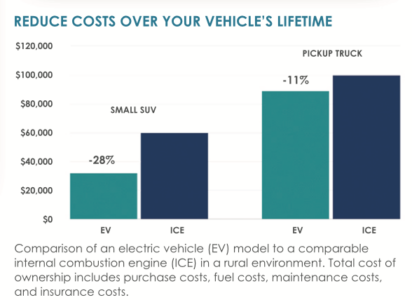
  • Public charging in New Mexico averages 38¢/kWhr. Charging at home is more convenient and less expensive.
  • Utility/Coop Time-of-Use electricity plans can lower the cost even more.  (~4 times less expensive than a gas fill up).
  • There are many Utility, Coop, State and Manufacturer incentives for home chargers. Check with program FIRST for a list of eligible equipment and what the incentive covers (i.e., product only or product + installation).
  • When buying a used EV, ask about potential charging capacity and connector plug limitations.
  • A charger can share a circuit with an electric dryer or other appliance, avoiding the need to a panel upgrade.
  • Programs for multi-family dwellings. Renters,  educate landlords.
  • Bi-directional charging can power your home!
  • Some vehicle manufacturers include a charger with purchase.  Charger manufacturers may also have sales/rebates
  • New Mexico. Clean Car ($400) OR Sustainable Building Tax Credit ($1,000 residential per product/installation for income <200% poverty level; $500 otherwise; $3,000/$1,500 commercial)
  • Utilities/Coops. Examples: PNM  Socorro Electric Coop (2026). More incentive information below.

EV Chargers 101

EV chargers come in 3 levels:

Slow.  Level 1 (120 Volts) is not a separate charger at all. Use your EV’s charge cord to plug into a standard AC 120 volt outlet at home. Adds ~ 5 miles of range per hour to your battery.
Faster.  Level 2 (240 Volts) for home (and some public charging) will charge your vehicle overnight, ~5-7 times faster than Level 1. It is usually much cheaper than public network chargers (especially if your electricity provider offers time-of-use rates for charging during off peak hours). It requires 240V. If you do not have 240V in your garage or carport, this may require a wiring upgrade (a few hundred dollars) and possibly an electric panel upgrade as well. There are State and electricity provider incentives to help with that.  But you may be able to avoid a panel upgrade by installing  a circuit splitter.  Read incentive fine print – some EV charger incentives will pay for making your residence EV ready vs. incentives just for the cost of the hardware.

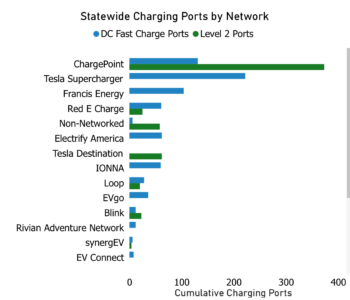
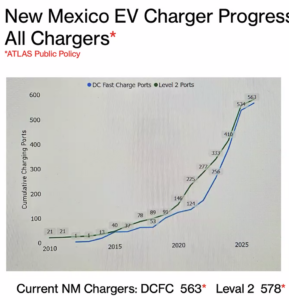
Public Chargers in New Mexico. Atlas.

These are found along roadways, like the Tesla Supercharging network. Charging speeds and technology are expanding as more cars are able to charge at higher voltages – the Hyundai IONIQ 5 adds 100 miles in 6 minutes at 800 volt/350 kW ultra fast DC chargers, for example.  But not all cars are compatible with the high electric loads of DC charging (Tesla Superchargers operate at 400V to 1000V with currents typically deliver 300A to over 600A), and not all fast chargers deliver the power needed to ensure a fast charge. If you are buying an older car make sure you understand its charging capability and constraints.
For new cars however, Ford, GM, Mercedes-Benz, Polestar, Honda, Kia, Jaguar, Hyundai, Genesis, and Rivian, Volvo and others have made Tesla connectors standard since 2024 so their vehicles can use the over 37,400 Tesla Supercharger ports at over 3000 US stations.  As of July 2026, New Mexico has 608 DC Fast charging pubic ports and 601 Level 2 ports.
Be aware that some public chargers may times during the day  when charging is less expensive.

Do frequent use of fast chargers degrade your battery? One study of real world data says no.

Be aware that charging connectors differ by vehicle model and region in the world.  Also for AC or DC charging. Connectors had been converging towards two types in the U.S., the Combined Charging System Combo and the Tesla connector.  A Magic Dock adaptor allows EVs with a CCS plus to charge at a limited number of Tesla Superchargers.  But a growing number of companies are adopting Tesla’s connector as standard.  Originally developed in Japan, the CHAdeMO is a DC fast charging connector, which may charge some models in the US like 2011-2021 Nissan Leafs and Mitsubishi iMiEV.
Many factors go into choosing and installing a charger and the project cost: any charging rate limits of your EV, charger location, if your electric panel and wiring need upgrading and if you will need any construction work.  See the video below.  Incentive programs may also limit your choices – so check with your electricity provide FIRST for both charger type and installer.
Here are some charger resources:

What’s involved in installing a charger:

As of June 2026.

EV Chargers – Financial Incentives

The U.S. Department of Energy’s Alternative Fuels Data Center is a great place to start when looking for all kinds of incentives in New Mexico. Also check for offers from the EV manufacturer.
With all the generous incentives, installing a charger should not cost most people very much.
  • New Mexico offers HEAR rebates for wiring ($2,500) and panel upgrades ($4,000) through program installers for low- income households. Check the state’s website for updates.
Level 2 chargers require a 240 volt outlet, which may entail upgraded wiring and possibly an upgraded electric panel. However, if you already have an electric dryer  near where you park your car you may be able to share this circuit. There are also devices for sharing charging between two chargers. Some people get all the range they need overnight with a Level 1 (120V) charger.
There are growing incentives for multi-family housing and commercial charging in addition to residential rebates and tax credits. Because it is always less expensive to build EV ready structures than retrofit them, EV Infrastructure Building Codes have been adopted in New Mexico and could be expanded. Expansion of time-of-use electric rates, which provide less expensive charging during off hours and rates for low-income households will allow more people to participate in clean transportation.
Charge Point’s EV Charger Incentives for Businesses
Clean Cities Coalition Network Workplace Charging Employer Workshop Toolkit.

For cities, schools, rural areas, non-profits, businesses, community organizations, shippers, states and individuals identify federal funding opportunities with this EV Funding Finder.
  • New Mexico State has two tax credits for chargers. You can only use one.
    •  Sustainable Building Refundable Tax Credit (SBTC) for personal or corporate income tax (01/01/2021 – 12/31/2027)
      • Basic minimum for EV Ready Equipment: 40 amp, 208 to 240 volt dedicated branch circuit.
      • Buildings less than 20,000 square feet.
      • Low-income: the owner or occupants of the building must have income equal or less than 200% of current year Federal poverty level
      • Residential (detached single family home) $500 for product and installation costs. $1,000 for charger and installation if low-income or affordable housing.
      • Commercial (multi-family and all other buildings) $1,500 for charger and installation; $3,000 if affordable housing or low income.
    • Clean Cars Tax Credit provides $400 for a Level 1 or 2  EV charger.
  • Rebates from electricity providers
      • PNM’s EV charger Program.  Residential customers can get Level 2 rebates up to $500 for specific chargers (list updates monthly; Tesla chargers may qualify in the future) = $1,500 for installation; $4,250  for chargers and installation if you are low income). Rebate customers are automatically enrolled in low-cost, time-of-use rates (see below). Multifamily communities with 5+ units have rebates of up to $5,000/charger port and income qualified communities rebates are up to $10,000 per charger port. PNM also has programs for commercial customers, including public charging, workplaces, fleets and mass transit.  Find a PNM Program Authorized contractor.
      • El Paso Electric offers a Smart Charging Program $500 rebate for the purchase of a qualifying level 2 charger ($600 income qualified) and the Home Wiring Program rebates for the installation costs associated with a new 240-volt electric outlet for EV home charging ($1,300 and $1,800 for qualifying income-qualified customers). Up to $2,500 rebate if panel upgrade is required. Customers must enroll in EV Smart Rewards program or the Whole-House EV Rate Plan.
      • Xcel’s EV Charging program. Charger and Wiring Rebates – Sign up for an EV Charging program below and get $800 back on charger and/or wiring. Up to $2,500 for income qualified or underserved communities. Time of Use plans:  Optimize Your Charge – annual $50 bill credit for following an off-peak charging schedule. Or Charging Perks  –  an annual incentive of $70 and a $50 sign up bill credit for charging when it’s most beneficial to the electric grid.
      • Some Rural Electric Coops offer rebates (for example, 50% off the cost of equipment and installing a residential Level 2 charger up to $500) or even free EV chargers. CNMEC offers the former and also 50% off up to $1,000 for charger and installation (including panel upgrade) if you sign up for their time-of-use program.
      • Also look for incentives from EV companies, EV charger manufacturers, local government, Chargelab rebate finder, EdmundsChargepoint,  Electric For All (utility-based) and Energy Sage.
      • Look for electrician ads.