
Electric Vehicles
The Bottom Line
- Driving electric is fun, convenient and avoids dumping 4-8 tons of CO2 (and other pollutants) into the air every year.
- EVs have very low maintenance costs and fuel costs of less than $1/gal equivalent if you charge an EV at home and use a special utility rate like the PNM’s Whole-Home EV rate. There are generous charger incentives too.
- Road trips. The extensive public charging system continues to grow. Try out a trip planning app to see your route and charging times.
- EV batteries now outlast their cars, and are so reliable they are being used to stabilize the electric grid either for repurposed second-life storage or via bi-directional charging at your home.
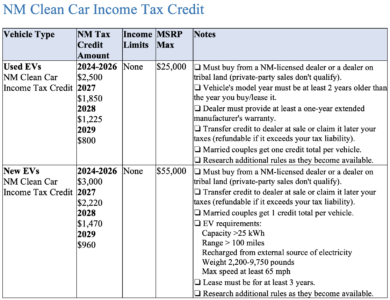
- There are New Mexico, Utility and Manufacturer incentives for buying or leasing new or used Battery Electric, Plug-In Hybrids and Fuel Cell Vehicles.
- New Mexico state tax credit – the amount is stepping down through 2029.
- If you do not pay State taxes you may still receive the Clean Car tax credit.
- State credit for pre-owned vehicles requires you have a 1-year warranty issued by the dealer.
- Limited utility incentives for low-income residents. PNM waiver if utilities are included in your rent.
- More information on incentives below.
Why Electric Vehicles?
 All electric vehicles (EVs) produce lower lifetime emissions (including emissions from mining, manufacturing and even if the electricity is generated by fossil fuels). EVs have 60% of the maintenance costs, lower fuel costs ($1.35 per gallon-equivalent) and lower lifetime costs* compared to gas-powered vehicles. Insurance rates may be higher, however. *July 2023 Cost of Ownership Report
EVs can easily accommodate the range requirements of most Americans (who on average travel less than 50 miles daily) and for homeowners at least, convenient overnight charging fills the “tank” by morning. Surveys consistently show that EV drivers love their cars because they are fun to drive, reliable, convenient, safe and less expensive to operate.

-
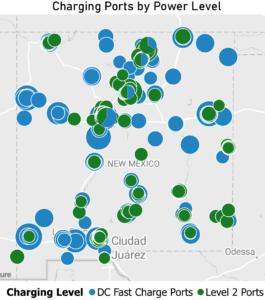
The NM charging network continues to grow.
EVs will be even less expensive to drive as utilities roll out “time-of-use” rates and demand-response programs. For example, PNM’s 10 pm-5 am rates “fills the tank” for about the cost of a gallon of gas.
- Battery range, battery “health” and charging networks (including in rural areas) are increasing.
- Technological innovation and entrepreneurial spirit are driving advances in cleaner battery materials, recycling and repurposing batteries for other uses after their 15-20 year-life span in vehicles.
- EVs are also becoming an important source of flexibility and backup for the electric grid as it faces growing demand. With bi-directional charging they provide backup storage for homeowners as well.
- More affordable EVs are coming. You can order a Slate basic electric truck for $25,000. The number of EVs under $42,000 is projected to double from 8 models in 2025 to 17 in 2026. Great deals are available on used EVs, although with soaring gas prices, demand for EVs and their prices are rising.
- Learn from 350NM’s own Tom Solomon on why to buy an EV through this video and slideshow.
The largest source of CO2 emissions in the U.S. is transportation. Ideally, we’d all walk and bike more, or at least rely on public transportation. But given the long distances many New Mexicans travel this is not always practical. By driving electric we cut down on CO2 and reduce pollution that threatens the health of 45 million Americans who live close to busy roads and transportation hubs. Widespread transition to zero emission vehicles powered by clean electricity could save New Mexicans $3 billion in health care costs, 273 premature deaths, 7,380 asthma attacks and 32,300 lost workdays by 2050.

Electric Vehicles 101
Driving an EV feels different. It is quieter.  The acceleration from 0 to 60 is mind-blowing. Regenerative braking, which charges your battery, slows the car faster than coasting a gas-powered car.
An EV requires a change of mindset about fueling up – remembering to plug it in at night if you have a charger at home or having to stop more often on a road trip.
Here are some other points to consider.
Operating Cost.
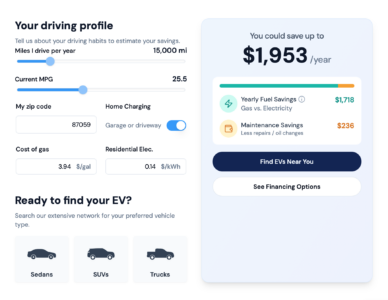
Coltura’s EV Savings Calculator
On average EV drivers save more than $1,000 a year over gas car owners in fuel and maintenance charges. Savings in New Mexico can be higher. Energy Sage estimates home charging in New Mexico costs about $535 a year compared with $1,255 for public charging and $1,264 for gas (2025 prices).
To see what you could save in operating costs check out Clotura’s EV vs. Gas Calculator. In addition to savings, it can also show new and used EVs for sale near you and their financing costs.
Lifetime costs (purchase, fuel and maintenance). EVs save consumers $6,000–$10,000 in lifetime costs compared to gas-powered cars. Assuming cleaner car regulations, a 2023 modeling study of future New Mexico adoption of electric cars, SUVs and trucks projects $14,000 – $16,800 in lifetime savings starting with 2027 models for urban residents and $5,000 (manufacturer year 2027) – $13,600 (MY2030) for rural owners.
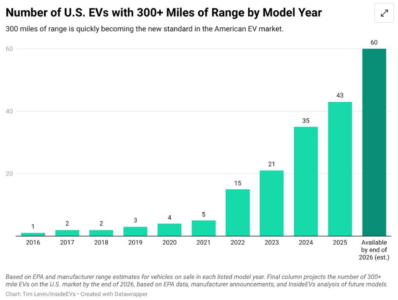
- In the U.S., the average range for new EVs is 325 miles. Some EVs can even travel farther (400-500 miles) than gas cars.
- For most people however, nearly all of the time, range is simply not an issue. In New Mexico, urban dwellers travel an average of 33 miles a day, suburbanites 46 miles and rural residents about 50. That is well within the lowest ranged new EVs, which travel 150-200 miles on one charge.
- Level 2 home chargers can “fill up” your EV overnight. Public, work and apartment charging networks are growing steadily, and apps will direct you to chargers, tell you how many spots are open and how long it will take to charge.
- If your battery is low while you are out, you can make it last longer by driving slower, using seat warmers or other measures. Be aware that cold weather can decrease your range.
- Range is increasing with each new generation of batteries as are charging times (which EVs charge fastest?).
- Still worried? Read the articles below and visit Coltura’s website for the longest-range electric cars and the cheapest EVs with at least 200 miles of range, and 300-mile range or more.
-
Road & Track How Much EV Range Do You Really Need? Bigger has always been better in the United States. That changes with EVs. (April 2023)
- EcoWatch Want a New EV But Concerned about Range? A New Study Matches Drivers’ Needs with Vehicles. (March 2023)
- Electric vehicle range is more than enough for typical daily use in the U.S.
- Electric vehicles typically have a smaller carbon footprint than gasoline cars, even when accounting for the electricity used for charging.
- The greenhouse gas emissions associated with an electric vehicle over its lifetime are typically lower than those from an average gasoline-powered vehicle, even when accounting for manufacturing.

There has been concern about sourcing battery materials especially from countries with child labor and poor environmental oversight. Some car companies are addressing this through the Initiative for Responsible Mining Assurance, direct mining supervision and the development of alternate battery materials. Federal action and the growing market has sparked a rush of lithium mining in North America and the US, which ranks 5th in lithium reserves. (US and North America critical materials Reserves). Recently the world’s largest lithium reserve was discovered in Nevada. Demand for critical minerals will increase even without EVs as they are used in personal electronics (e.g, cell phones and laptops) and in nation security (e.g., satellites and missile systems)
However, it’s important to point out the larger picture. The amount of EV materials being mined is minuscule compared to all metal mined in the world, and the amount of materials consumed by a gas-powered car is 300-400 times greater than that of an EV battery. The fossil fuels industry extracts millions-of-years old carbon that is sent into the atmosphere where it is very expensive and technologically challenging to capture and where it causes global harm via air pollution and climate change. EV battery materials, in contrast, have local impact, stay on earth and can be recycled, ultimately reducing demand.
Investments in recycling are robust, but even before recycling, EV batteries can be repurposed. EV batteries are not like short-lifespan cell phone batteries, because they have extensive thermal management to slow degradation from temperature changes. So EV batteries that degrade to 75-80% of their capacity (after 15-20 years, 100,000-200,000 miles) are being repurposed for home, industrial and grid energy storage.
More Resources
EV technology, policy and incentives are changing fast. A very helpful organization for information about financial incentives, EVs and chargers is PlugIn America. Here are some other resources to stay in the loop.




Shopping for new and used EVs
Selected buying guides, car databases for sellers and buyers, and resources on loans and leases, FAQs, trends and news.






Incentives for New and Used EVs
-
- You must have a 1 year warranty from the dealer for used vehicles to get the state tax credit.
- NM state tax credits decrease over time.
We are not tax experts, so do not rely on this website for tax advice!