
Heat Pump Water Heaters Save Money & Are Better For You

MORE EFFICIENT. Just as heat pumps warm the air in your house, heat pump water heaters (HPWH) heat your water for showers, dishwashing, laundry and other needs. Because they don’t create heat, only collect it from the surrounding air, they are 2-3 times more efficient than most current hot water systems. HPWHs can save you hundreds of dollars per year. Use this calculator to see how much you can save.
 HEALTHIER. They can also be better for your health compared to methane (natural) gas and propane heaters. The least expensive gas water heaters use atmospheric venting (no fan) and waste energy by venting warm air, combustion gases like CO2, carbon monoxide, nitrogen oxides, and acidic water vapor through a pipe, chimney or flue to the outside. If the venting system is improperly installed, backdrafting may occur, in which exhaust gases are pulled back into the house.
According to one contractor, “this is a common defect identified during home inspections, and it’s almost always a condition that the homeowner or occupant is not aware of.” Another site notes that backdrafting can start after sealing the house for leaks during weatherization; the water heater, unable to get enough air for combustion, pulls it back through the flue. This is not only a health hazard, but the corrosive liquid can eat through metal and cause the heater to leak.
What will a Heat Pump Water Heater (HPWH) Cost?
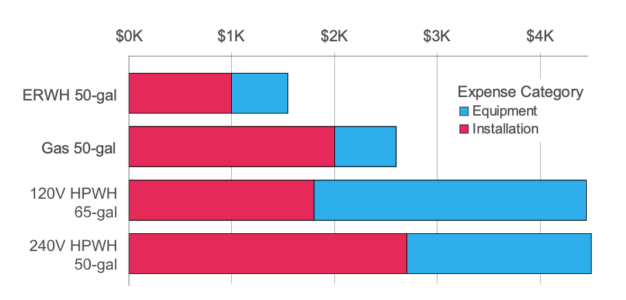
Installing a Heat Pump Water Heater (HPWH) costs more than gas and electric water heaters, many of which are low-to-medium efficiency. Luckily there are incentives that make HPWHs much more competitive. They may also be more affordable to run. Upcoming rules in 2029 will require higher efficiency gas water heaters, and electric water heaters will have to have heat pumps.
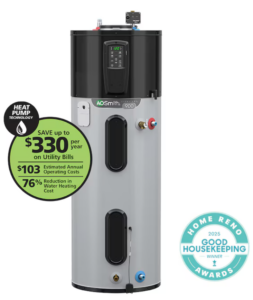
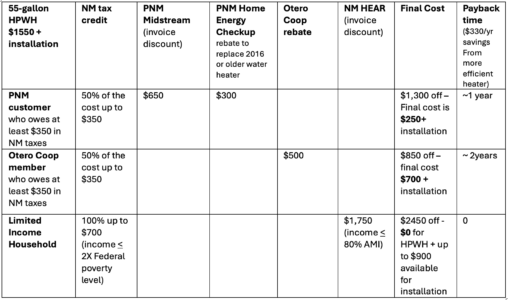
The table below illustrates what different New Mexicans might pay for this Consumer Reports recommended Smart Buy A.O. Smith Signature 900 50-gallon HPWH priced at Lowes for $1,550 (May 2026). Note: Most other HPWH are more expensive.
If you don’t already have an electric water heater there may be additional costs for adding a 240V line or buying a more expensive 120V model if appropriate. See more details and tips below.
What to know before you buy
-
- Emergency. As many as 90% of water heater replacements are done in emergency situations. Take the time now to learn about heat pump water heaters and pick a model you like.
- Signs that it’s time to replace your current water heater.
- How to find the age of your current water heater.
- Capacity. In general, you should increase your HPWH tank size by one unit compared to traditional electric or gas heater because HPWHs heat at a slower rate. So replace a 40-gallon tank with a 50 gallon or higher size. However raising the tank temperature from 125°F to 140°F adds an equivalent amount of available hot water as increasing tank capacity by about 10 to 15 gallons. A mixing valve can then lower the temperature at the faucet when needed by mixing the hot water with cooler water to avoid scalding. Some HPWH already contain mixing valves (especially 120 V models). If not, one can be installed in the hot water supply line. This costs ~$100 + 1/2 hr of labor and may have to be replaced once during the HPWH lifetime.
- Location. HPWHs will cool the room they are in. The cool air they expel can be vented outside if this is a problem. They perform best in locations that remain in the 40–90°F range and that have access to 750 – 1,000 cubic feet of air (so closets are not ideal unless there are vents to the outside. Add louvers to closet doors if no other places are available). They also need a drain or pump for the clean condensate water the HPWH releases.
- Size. Be aware that HPWHs can be larger and taller than conventional water heaters. If space is limited, consider an ENERGY STAR certified split system (see photo). Nyle and Eco2 Systems make split system HPWHs with a separate outside unit or condenser.

- Consider a smart recirculating system to deliver hot water faster right when you need it especially in large houses. Do not install a continuously operated circulation pump which would force your HPWH into electric backup mode which uses a lot more energy.
- If you are replacing a gas water heater with a HPWH, you may have to upgrade your electrical panel and wiring because HPWHs typically require a hardwired, dedicated 240 Volt circuit. Also, for many homes, adding a 30-Amp appliance means an electrical panel upgrade to accommodate more current. However, there are now 120 volt HPWH models that plug into a standard outlet. More information on 120 volt models is below.
- Search for “heat pump water heater” or “Hybrid High Efficiency” when shopping for a HPWH. Most heat pump water heaters are called hybrid because they come with an electric heating element as backup when a lot of hot water is needed all of a sudden.
- Noise. If the water heater is going to be near bedroom or other living space, might want to look at noise ratings.
- Federal Tax Credit has expired: In order to qualify for the Federal Tax Credit, a model must meet or exceed the highest efficiency tier (not including any advanced tier) established by the Consortium for Energy Efficiency at the beginning of the year you install the HP Water Heater. Check for your model in this database or see if it qualifies for an Energy Star Rating (advanced tier).
- Rheem, A.O. Smith, Nye and GE now have 120 volt models. Because they plug into a standard wall outlet and don’t require any special upgrades, 120V HPWHs will have lower installation costs and further increase household savings, as explained in this slide deck. They would be great for home additions. To learn more about 120V HPWHs watch this Oct. 2023 Electrify Now webinar or read these CleanTechnica articles by J120 Volt Heat Pump Water Heaters Hit The Market & Make Gas Replacements Even Easier and Rheem Releases 120V Plug-In Heat Pump Water Heater That Can Be Plugged Into Typical Outlet. Energy Vanguard page on 120V HPWH.
 Be aware that 120V HPWH are often larger than 240V models because they have slower heating speeds and therefore need to have larger storage tanks. Replace a 50-gallon gas unit, for example, with a 65- or 80-gallon 120V HPWH, which may require two people to move.
gallon 120V HPWH.
- Be aware that the 120 V plug-in models work best in warmer climates. For mid to northern New Mexico, they should be placed inside a home or protected from ambient cold temperatures in winter in a garage.
Resources

Electrify Now webinar on Heat Pump Water Heaters
CleanTechnica A Heat Pump Water Heater is the energy saving equivalent of 7 solar panels and costs ⅙ the price.
Advance Water Heating Initiative has Resources for single- and multifamily housing.
ENERGY STAR resources. Consumer Reports HPWH ratings.
CleanTechnica Dec 2022 review of the Voltex AL HPWH
Canary Media Finally, a heat-pump water heater that plugs into a standard outlet.
The Uniform Efficiency Factor (UEF) indicates how many units of energy a water heater produces for every energy unit put in. A typical heat pump water heater UEF is 4.02 versus 0.60 for gas, 0.81 for instant gas, and 0.92 for electric. Energy Star UEF Criteria
Shopping and Installing
Note: Some tax credits require an inspector to sign off on an installation. Make sure your contractor is a certified electrician and a certified plumber.
Search for “heat pump water heater” and “Hybrid High Efficiency” when shopping.
-
- Wirecutter How to Shop for A Heat Pump Water Heater (July 2024)
- DIY Installation Guides
- Electrify Now DIY HPWH Install video
- ENERGY STAR Heat pump water heaters-products
- ENERGY STAR Find installers and retailers near you
- Find an authorized dealer/installer in New Mexico for some manufacturers

