
Solar and Storage Facilities
New Mexico is energy-rich, with the highest solar potential of any other state. Unlike the oil, coal, gas and nuclear industries, renewable energy has overwhelming advantages:
- Water. Solar only uses water in the construction phase to control dust. Compare this to BILLIONS of gallons of freshwater and brackish water for drilling and fracking plus 100 to 1,100 gallons per megawatt hour for cooling power plants. Most New Mexico solar farms rarely or never use water to clean their panels. Nationally, water use for cleaning is about 20 gallons/megawatt hour vs. 10,000-30,000 gallons/megawatt hour for fossil fuel power plant operation.
- Pollution. Unlike fossil fuels, which dump 75% of the 59 gigatonnes of planet-heating gases into the air each year, solar and wind produce no climate or air pollution. Air pollution from fossil fuels account for 50,000 deaths in the U.S. and 7.9 million premature deaths globally each year.
- Every day, almost 2,000 young children die due to air pollution – more than one every minute. That makes it the second-leading cause of death in young children, after malnutrition. Source: State of Global Air.
- Biodiversity
- Land use: Golf courses take up nearly 4 times more land than solar energy installations, which occupy only ~0.04% of total US land area. Fossil fuel extraction, pipelines, refineries and power plants take up a lot more New Mexican land, with extraction on BLM land alone accounting for 5.3% of the state.
If you are concerned about rising temperatures, water shortages, tree death, lowered agricultural and livestock productivity, then you are concerned about how climate change is impacting our state. These problems will continue to worsen until we stop burning fossil fuels.
Luckily we have relatively inexpensive (free fuel!) replacements available today – solar, wind and other zero-carbon renewables to replace oil and gas. Geothermal is another up and coming, 24/7 renewable, carbon-free resource growing rapidly in New Mexico.
The majority of New Mexicans support solar farms in their area and a transition to clean energy.
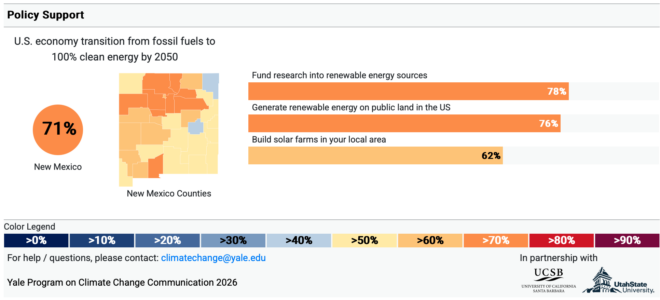
Unfortunately, some community and utility-scale solar farms face opposition, sometimes driven by national pro-fossil fuel groups with campaigns of misinformation. (Floodlight. An activist group is spreading misinformation to stop solar projects in rural America)
That is Why YOU matter. A few people turning up in support of a solar project can make all the difference.
Canary Media. How to stick up for renewable energy projects near you.
Volts. How to respond to disinformation about clean energy, at scale (podcast) Goodpower.org.
A watt (W). The average smart phone charger uses 5 watts, desktop computer, 100 watts.
A kilowatt (KW) = 1 thousand watts. The average toaster uses 1,2 KW, air fryer –1.5 KW, dryer –3 KW.
A megawatt (MW) = 1 million watts. 100 MW can power 120,000 New Mexican homes for a year.
A gigawatt (GW) = 1 billion watts. GW scale power plants include the Hoover Dam and nuclear plants. New Mexico has the potential to produce 163 GW of power from geothermal.
A watt-hour (Wh) is a unit of energy. New Mexico homes use an average of 488 kilowatt-hours of electricity per month.Capacity versus delivered power. Capacity is the maximum amount of power a plant can generate. For solar this means the amount of electricity on a sunny day. But on cloudy days and at night, less or no electricity is generated. To account for this, a capacity factor is used. It is the ratio of the actual energy output divided by the theoretical maximum if the plant operated 24/7. The average US solar plant capacity is 25%, but the figure is closer to 30% in the southwest. Tracking can boost capacity. If storage is added of course, the capacity factor of the entire facility increases substantially.
Solar farm developers use several other terms to reflect the actual output, as shown in the table. Solar cells produce DC power, which is usually converted to AC power by inverters and sent to the grid. So for example, Megawatt AC (MWac) shows utilities the maximum AC power the farm can deliver.

Land Use and Farmland
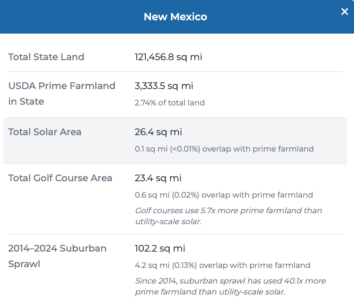 New Mexico solar farms account for a tiny sliver of the state’s total land area (0.0002%) and less than 0.01% of the 3,333 square miles of prime USDA farmland.
The greatest threats to farmland are suburban sprawl and golf courses, not to mention rising temperatures, aridification and water shortages due to fossil fuel-driven climate change.
Solar farms not only replace fossil fuels but they can cool farm and ranch land, reduce evaporation and irrigation needs and promote soil health. They also provide a stable revenue stream for farmers and ranchers.
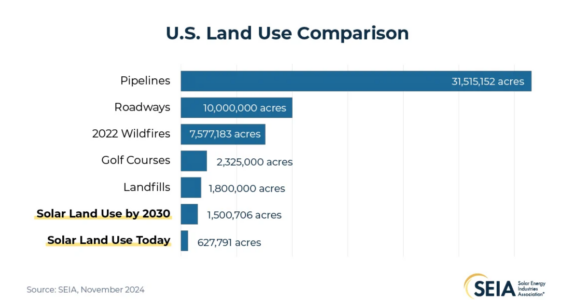 In contrast, 4.1 million acres of NM land is leased by the BLM for fossil fuel extraction accounting for 5.3% of NM’s 77.6M acres. Then there are 17 gas-fired and 1 coal fired power plant plus an extensive network of pipelines. Areas like this one near Loving, NM are real hell-scapes. That damage to the land, wildlife, our health and climate are the ongoing costs of depending on fossil fuels
Why can’t the solar panels just go on roofs, Walmarts and parking lots?
Solar on parking lots and rooftops (including Walmart’s which has installed a lot of solar on its stores) do contribute to the grid. But they will never be enough. There is just not enough space to generate the energy we need, and the cost of building small systems one by one on top of existing infrastructure or brownfields is too expensive and fraught with myriad barriers. In 2025, small solar systems accounted for only 2% of New Mexico’s electricity generation.* We need solar farms’ economies of scale, and we need a lot of them.
A 2021 Stanford study estimates that only 55,000 acres (0.07% of NM land) used for utility scale solar farms, plus most roofs, plus additional wind farms and some geothermal, could achieve a 100% renewable energy system, for all purpose in our state. That means that for every year for 20 years, we would need to build 6 new 50MW solar farms and 1 new 200MW wind farm – and that estimate was developed before the rush to data centers.
*2025, EIA. Net generation. Small-scale PV 841 (2%), Utility Scale solar 6,104 (15.5%), Wind 14,215 (36.2%), Natural gas 10,507(26.8%) All fuels 39,167 (thousand MWhrs in one year).
Property Rights
Economic Benefits
Water
U.S. thermal power plants are the #1 water user in the U.S., at over 40% of total U.S. water withdrawals in 2015 (per EIA). Replacing the power from a coal or gas power plant with solar energy is perhaps the single best way for New Mexico to save water. Solar developers are required to use water to suppress dust during construction, but most New Mexico facilities do not wash their panels.
If solar is being placed in a farm or ranch, the panels can save irrigation water by shading plants (and livestock). The panels lower soil temperature and plant evapotranspiration. This is called agrivoltaics or agrisolar and can be used for conservation measures as well.
Wildlife
- The Renewable Energy Wildlife Institute.
Solar Energy Report.
Wind
Energy Siting Resources - BIRDS. Audubon supports thoughtfully sited solar and wind developments everywhere including the Southwest. The organization stresses that climate change is the greatest single threat to birds.
- There is little evidence supporting the idea that birds in the desert southwest mistake solar farms for water bodies.
- Pollinator Gardens, enhanced diversity
New Mexico Facilities
Solar Farms in New Mexico
Battery Storage in New Mexico
Who is attacking renewable energy and spreading misinformation?
Pro-natural gas group
Pro Solar Groups
American Farmland Trust
Renewable Energy Farmers of America is America’s first and only national association focused on helping landowners navigate renewable energy opportunities
Veterans Power America
Other great resources
Third Act’s Solar Advocates
Greenlight America Resources
Sabin Center for Climate Change Law. Rebutting 38 False Claims About Solar, Wind, Electric Vehicles, and Battery Storage